Materials & sleep
How Latex Layers and Wool Quilting Shape Sleep Comfort
In a well-built mattress, comfort is not the work of a single material. Latex gives the body a responsive foundation; wool above it can soften the surface, move moisture, and moderate temperature. Their position, thickness, and construction influence how the whole bed feels—and how it holds up over time.
Published November 5, 2026
Lift the cover of a layered mattress and the materials tell a quiet story of cooperation. A dense core carries weight. A more yielding layer lets shoulders and hips settle. Above them, a quilted surface may add a little cushioning and help manage the warmth and moisture that gather during a night of sleep. In some natural designs, latex and wool share these duties, though they do not do the same job.
Latex is a springy material made from rubber-tree sap or produced synthetically from petrochemical ingredients. Wool is an animal fiber, often used as batting or quilted fill. In a mattress, latex commonly supplies much of the contouring and support, while wool near the surface provides a softer transition and can absorb water vapor. Understanding where each material sits—and what it is expected to do—makes product descriptions easier to interpret than a simple list of “natural” ingredients.
There is no universal arrangement that guarantees a particular night’s sleep. Body shape, sleeping position, room temperature, the bed base, and personal preference all matter. But a closer look at latex layers, wool quilting, construction details, care, and certification can help readers compare designs with clearer expectations.
What latex contributes to a mattress
Latex compresses under pressure and springs back when that pressure is removed. This resilience gives it a buoyant, responsive feel. Rather than slowly molding around the body in the way some foams do, latex generally pushes back more readily as a sleeper shifts position. The sensation varies with the formulation, firmness, thickness, and design of the layer, so “latex feel” is not one fixed experience.
In a mattress, latex may appear as a thick core, a thinner comfort layer, or several layers arranged in sequence. A core is often intended to provide the main structural support. Softer latex above it can create more surface give, allowing parts of the body to settle without requiring the entire mattress to feel soft. In layered designs, the combined effect matters: a thick soft layer over a firm core will behave differently from a thin soft layer over the same core.
Latex may be made using the Dunlop or Talalay process. These names describe different manufacturing methods, not a simple ranking from better to worse. Dunlop latex is produced by placing a latex mixture in a mold and vulcanizing it. Talalay production includes additional steps, such as vacuum expansion and freezing before vulcanization. Those processes can yield different textures and characteristics, but the actual feel depends on the finished material and its specifications. It is more useful to compare firmness, layer thickness, construction, and return policies than to assume one process will suit everyone.
Also distinguish natural, synthetic, and blended latex. Natural latex is made from rubber-tree sap. Synthetic latex is made from synthetic rubber, while blended products combine natural and synthetic components in varying proportions. A label that says “latex” alone may not explain which kind is used. If material origin is important, look for a clear description of the latex and supporting documentation rather than relying on a broad front-label claim.
The architecture of layers
A mattress is a small structure designed to respond to a moving body. Its layers interact much like parts of a landscape: the foundation determines the broad shape, while the surface changes how that terrain is encountered. A latex core that is too soft or too firm for a particular sleeper may not be corrected simply by adding wool quilting. Likewise, a comfortable quilted top cannot replace a thoughtfully designed support layer.
When assessing construction, ask what each layer is meant to do. A useful description identifies materials and thicknesses, explains the order of the layers, and provides some indication of firmness or density. If a mattress contains multiple latex layers, find out whether they are the same firmness and whether they can be rearranged or replaced. A removable cover may make inspection or repair easier, but it does not automatically mean that the cover or the internal materials are washable.
Thickness alone does not determine comfort. Two mattresses with the same overall height can have different proportions of core, cushioning, and quilting. The dimensions of each layer, the material’s firmness, and the way layers are attached all influence the result. A thick comfort layer may feel more enveloping than a thin one; a tightly quilted cover can make a mattress feel firmer at first contact than a loose, cushioned surface.
The supporting base is part of the system too. A mattress placed on an incompatible or uneven foundation may not perform as intended. Follow the manufacturer’s guidance on slat spacing, platform support, and adjustable bases. Proper support helps the mattress retain its shape and can be relevant to warranty coverage.
Why wool is used in quilting
Wool fibers can absorb moisture vapor while still feeling relatively dry to the touch. That property makes wool a common choice for bedding and mattress quilting, where it may help buffer the small changes in humidity that occur as the body releases heat and moisture during sleep. Wool is also naturally resilient, and its crimped fibers can create a soft layer of loft when processed as batting.
In a mattress, wool is usually placed close to the cover, either as a quilted layer or as part of a topper. Its role is not necessarily to provide deep pressure relief. Rather, it can create a gentler surface, soften the transition to firmer latex below, and influence how the bed feels against the skin. The effect depends on how much wool is present, how densely it is quilted, and whether it is combined with other materials.
Wool is often described as temperature regulating. That phrase should be understood in context: wool can help manage moisture and can contribute to a more comfortable microclimate, but it does not actively cool a sleeper or guarantee that a mattress will feel cool in every room. Mattress covers, sheets, pajamas, humidity, and individual heat sensitivity all influence perceived temperature.
Wool may also be used for its natural resistance to ignition, but claims about fire performance need careful interpretation. A finished mattress must meet the safety requirements that apply in its market. The presence of wool does not by itself explain a product’s full fire-safety design, nor should it be taken as a substitute for checking the manufacturer’s compliance information.
How latex and wool work together
In a latex-and-wool design, the materials can divide tasks. Latex supplies resilient support and contouring; wool adds a softer, more absorbent surface layer. The resulting feel may be a combination of buoyancy below and gentle cushioning above. Because wool can compress over time, its quilting may settle with use, while latex may retain a springy response. The precise outcome depends on the construction, not just the materials named on the label.
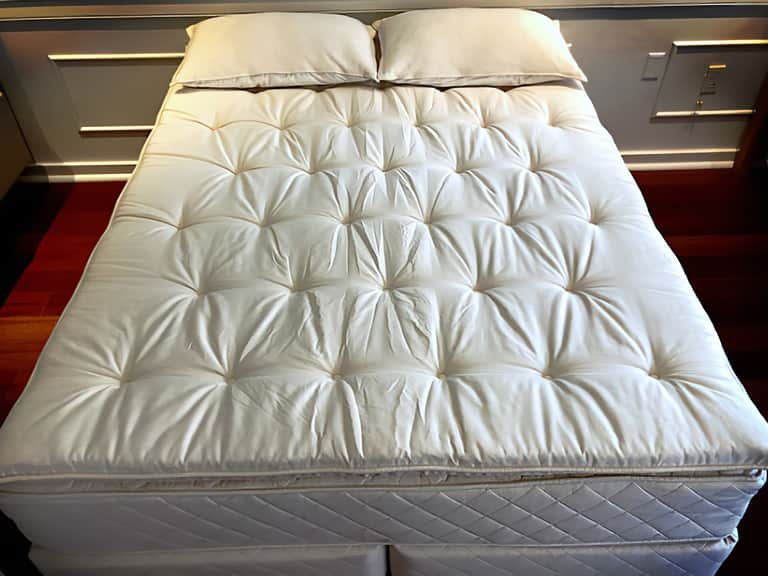
Consider the Naturally Organic Hudson Luxe Latex Mattress as one example of this layered approach. Its described construction includes a five-inch firm Dunlop latex core, a three-inch medium Dunlop latex layer, and an organic cotton and wool encasement. The product also includes a topper containing organic wool and Dunlop latex. This arrangement illustrates how a manufacturer may combine firmer support with a more cushioned, enveloping upper section. It is an example of construction, not a universal formula; comfort remains personal, and specifications should be checked directly before purchase.
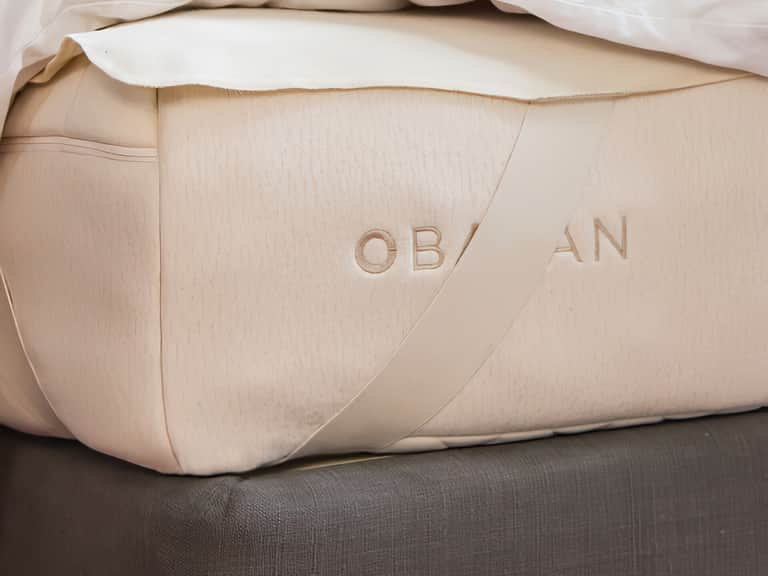
Wool can appear in more than one form, and it is important not to confuse a mattress’s internal quilting with a separate moisture pad. A wool pad placed on top of a mattress may provide a protective or cushioning layer, but it is not the same as wool incorporated into the mattress cover. For instance, the Obasan Organic Wool Moisture Pad Protector is a separate wool protector intended to sit over a mattress. Its care instructions differ from those of a built-in quilted layer. Understanding this distinction helps prevent assumptions about washability, feel, or the mattress’s internal design.
Certification: what the labels can and cannot tell you
Certifications can help verify particular claims, but they do not answer every question about comfort or performance. Two names commonly encountered in organic bedding are GOLS and GOTS. The Global Organic Latex Standard (GOLS) addresses organic latex and includes requirements related to processing and supply-chain controls. The Global Organic Textile Standard (GOTS) applies to textiles made with organic fibers and sets criteria for processing, environmental management, and social practices within its scope.
A certification applies to a defined product, material, facility, or supply-chain claim according to the relevant standard. It should not be treated as proof that every component of a mattress has identical certification or that a whole product has been certified when only one part has. Check the exact language used by the manufacturer, the scope of the claim, and whether certification details are available. If a product is described as containing certified organic latex, for example, that statement is more specific than a vague claim that the entire mattress is “natural.”
Certification does not rate firmness, comfort, durability, or suitability for a particular sleeper. Nor does the word “organic” explain every processing step or disclose the complete bill of materials. For a well-rounded assessment, combine certification information with a layer-by-layer description, care instructions, warranty terms, and clear answers about the origin and type of latex and wool.
Questions to ask when comparing mattresses
Marketing language often compresses complicated construction into a few appealing words. A short checklist can bring the comparison back to practical details:
- What kind of latex is used? Look for whether it is natural, synthetic, or blended, and whether it is Dunlop or Talalay.
- How thick is each latex layer? A layer-by-layer breakdown is more useful than total mattress height alone.
- What is the intended role of each layer? Identify the support core, comfort layer, quilting, and any separate topper.
- How is the wool used? Ask whether it is integrated into the cover, placed in a topper, or supplied as a separate pad.
- What certifications apply, and to what? Confirm the standard and the specific materials or components covered.
- What are the care requirements? Spot-clean-only covers and hand-washable pads require different routines from machine-washable bedding.
- What foundation is recommended? Check support requirements, including any guidance for slats or adjustable bases.
- How can comfort be evaluated at home? Review the trial period, exchange terms, delivery details, and warranty before committing.
Care, settling, and longevity
Natural materials still need appropriate care. A mattress cover containing wool may be designed for spot cleaning only, while a separate wool protector may have instructions for airing, gentle washing, or line drying. Follow the instructions for the specific item: heat, agitation, or improper drying can shrink or damage wool. Do not assume that a removable cover is machine washable unless the manufacturer explicitly says so.
Wool quilting can settle as fibers compress under repeated use. That change may alter the surface feel, though it does not necessarily indicate that the underlying latex has failed. Rotating a mattress may help distribute wear if the manufacturer recommends it; some designs are not reversible because their layers are arranged for use on one side. The care guide is the best reference for turning, rotating, or airing a mattress.
Latex resilience may help a layer spring back after pressure, but no material is immune to wear. Longevity depends on formulation, construction, use, support, and care. A warranty can offer protection against certain manufacturing defects, but it is not a promise that a sleeper will remain comfortable for a specific number of years. Read what the warranty covers, how it defines an eligible defect, and what conditions may void coverage.
Comfort is a system, not a label
When comparing a latex mattress with wool quilting, it is tempting to focus on a single word—organic, breathable, supportive, or cooling. Each describes only part of the picture. The feel beneath the body emerges from the firmness and thickness of the latex, the amount and placement of wool, the cover’s construction, and the surface supporting the mattress.
Start with the questions that matter most to the sleeper: whether the surface feels too firm or too yielding, whether changing positions is easy, and whether the bed stays comfortable across the night. Then examine the construction that might explain those impressions. A detailed materials list and credible certifications can help clarify what is inside, while a clear trial and return policy acknowledges the simple reality that comfort cannot be fully predicted from a label.
Latex and wool are not competing answers to the same problem. One can provide a responsive foundation; the other can soften the meeting place between body and mattress while helping manage moisture. When their roles are plainly described and the complete design suits the sleeper, their combination can make a thoughtfully layered sleep surface. The useful question is not whether either material is best in isolation, but how each one is used—and whether the whole arrangement works for the person who will sleep on it.